Human Escalation Design in AI-Assisted Customer Success Workflows
Escalation rules must be designed before AI acts, not written after problems surface.
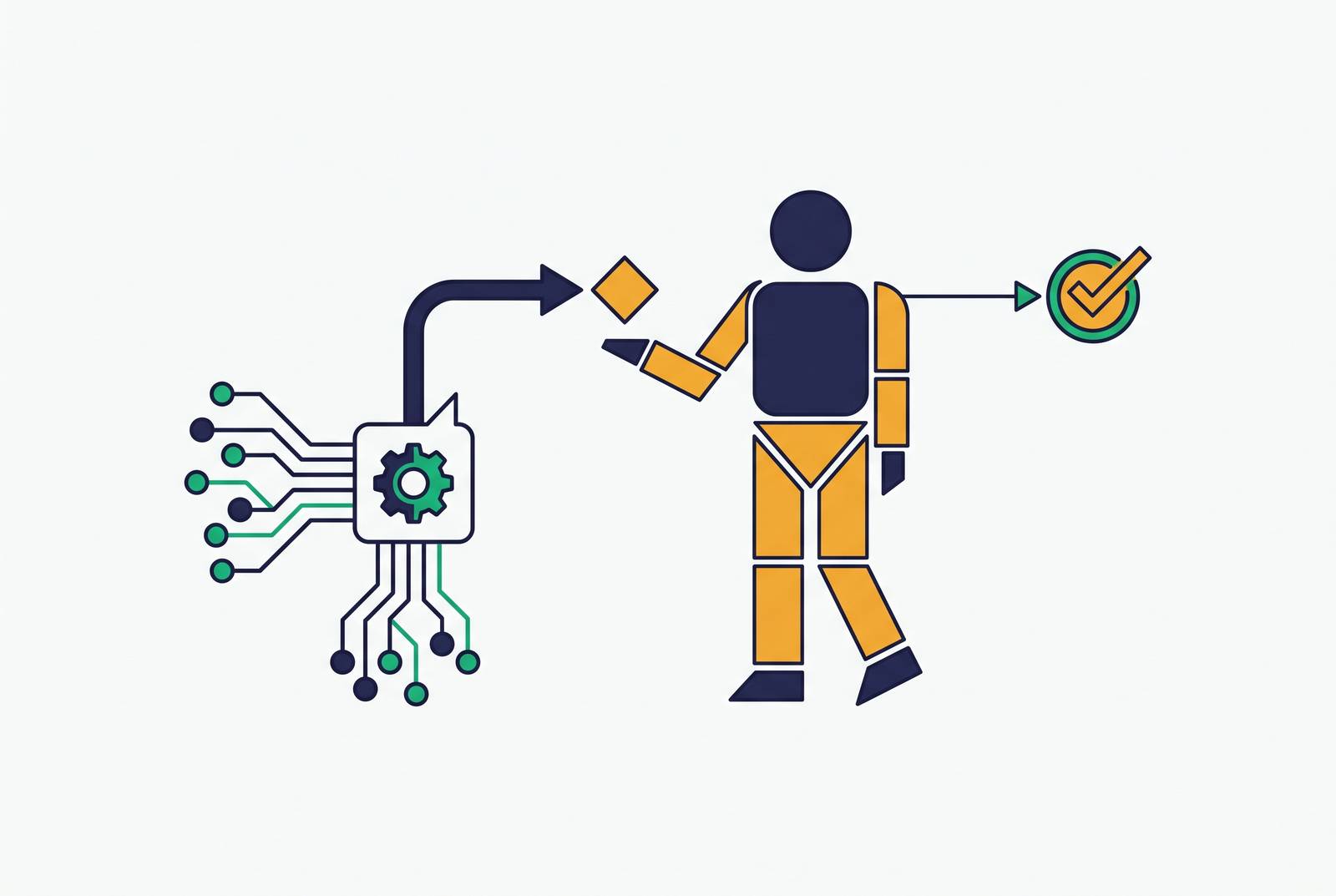
Escalation design is an architectural choice made before any message goes out, not a safety net triggered after something goes wrong. That distinction matters more now than it did two years ago, because AI in B2B SaaS workflows has moved from copilots that suggest a next step to agents that research an account, act on it, and iterate without a human approving each move. A missing escalation rule used to cost a team a bad draft sitting in a queue. Today it costs an autonomous action taken on a live customer, sent, logged, and done before anyone reviews it.
That shift changes where the real decision point sits. Once an agent can send a message, trigger a workflow, or skip a customer on its own judgment, the human's last clean chance to intervene is at campaign design, not at the moment a specific message is about to go out. By the time a message is queued, the agent has already decided. Waiting until then to ask whether a human should see it first treats escalation as damage control.
Most teams still build it that way. Routing rules get written reactively, after a bad outcome surfaces: a nudge lands in the middle of a renewal negotiation, a customer with an open complaint gets a cheerful adoption tip, and only then does someone sit down to write the rule that would have stopped it. That sequence, agent acts first, human cleans up second, is fallback thinking dressed up as process. A deliberate escalation architecture inverts the order. It specifies, before any campaign runs, which signals, account states, and behavioral gaps sit outside the agent's approved scope and require a human before any action happens. The rest of this piece builds out what that specification actually looks like.
What AI agents can handle without human review
The case for escalation only makes sense once the opposite case is clear: most of what a well-scoped AI adoption agent does, it should do without a human checking each message first. Within an approved campaign, an agent working from product behavior and database state can make grounded, individual decisions and send them; requiring sign-off on every single one defeats the reason to use the agent.
"Approved campaign" has a specific shape. A human defines the adoption goal, the qualifying audience, the guidance the agent is allowed to give, and the limits it has to respect, and that happens once, before the campaign runs, not message by message. Inside that scope, the agent evaluates each eligible person on their own: does this individual's behavior, right now, justify a message, based on what the database actually shows about their state? Skip-if-unsure logic, frequency caps, quiet hours, and never-contact flags get enforced at the send gate itself, as infrastructure, rather than left as instructions hoping the model follows them. That's what bounds the agent's autonomous range without forcing a human to look at every case.
What this setup enables is high-volume, structured judgment: spotting a behavioral gap, matching it to an approved type of guidance, and writing a message grounded in something specific, a task retried five times, a feature that never got opened across dozens of sessions, at a scale no human team could sustain. Userlens's approach to adoption guidance illustrates the principle directly. A campaign brief sets the goal, audience, guidance, and limits once, and its adoption agent, Lumi, then investigates each eligible person independently, sends only when the evidence supports it, and skips when it doesn't, with no per-message approval required inside that scope. Autonomous operation within guardrails is the design goal here, not a risk to be managed down.
One measurement question separates real autonomy from a shell game: resolution rate versus deflection rate. An agent that routes a customer away from human contact without changing what that customer actually does in the product hasn't accomplished anything an autonomous system should be credited for. The test is whether behavior in the product changed, not whether a human got skipped.
The signals and account states that should stop an agent before it acts
Escalation conditions aren't edge cases to improvise around later. They form a finite, plannable list that can be defined ahead of time and enforced at the send gate, before any message reaches a customer. Four categories cover most of what belongs in that list.
Account-state signals change the stakes of any message regardless of how well-written it is. An account in active renewal, negotiation, or contract review is a bad place for an AI-generated nudge, because that nudge may step on a conversation a human is already having. An account with an open, escalated support ticket or an unresolved complaint doesn't need a product-adoption message layered on top of a customer who has already signaled distress. A stakeholder who has flagged a never-contact preference is a permanent routing rule that belongs in the database, enforced automatically rather than left to a prompt someone hopes the model reads correctly every time. And B2B accounts rarely have one point of contact: end users, managers, IT, procurement, and executives are often all present on the same account, each measuring success differently. An agent that can't tell which stakeholder it's about to message, or what that person's role actually is, should hand the decision to a human.
Behavioral patterns make up the second category, specifically the ones the agent has no reliable way to diagnose. Sustained inactivity that doesn't match any known pattern in the training data should be flagged, but it shouldn't trigger an assumption that a guidance message will fix it. Drift that looks churn-adjacent could just as easily be a workflow change, a team reorganization, or a seasonal lull, so a gap between expected and actual behavior is a signal to note, not proof of an adoption problem. A sudden spike in usage on an account with no prior engagement history might mean a new hire, a new use case, or a trial evaluation in progress, any of which calls for a human's personal message more than an automated one.
Message content marks the third category: anything that drifts outside informational guidance. A message that would commit to a discount, modify a contract, or change a configuration requires human authority, not just human awareness that it happened. The same goes for any situation where the agent can't confirm it actually has standing to recommend the next step. B2B queries often touch compliance-sensitive data, span multiple systems, or depend on a workflow custom to that account, and resolving those requires investigation a single guidance template can't do. An agent that recognizes it has hit that ceiling should route out.
The fourth category is about tone as much as content: situations that call for empathy. Emotionally charged language surfacing anywhere in a customer's prior support history needs to travel with the account record, not get stripped out before the agent looks at it. High-value accounts where the relationship itself is the retention mechanism deserve a human's judgment about timing and wording, because speed and personalization at scale aren't the thing that keeps those accounts.
Context handoff to humans
An escalation is only as useful as what accompanies it. Most systems lose precisely the context that would make a human's intervention worth having, and that loss turns a well-designed trigger into a dead end.
A handoff that works carries specific behavioral evidence, not a vague summary. "Account health declined" tells a human nothing actionable. "This person retried the same task five times this week and has never opened the relevant feature across any session" tells them exactly where to start. The handoff should also carry the account's current database state: plan, configuration, role, what's already been sent, when, and what response it got. It should include the guidance the agent was about to send and the specific reason it stopped, so the human can decide to send it as is, edit it, or do something else. And it should carry any prior support or sentiment history attached to that account, so the human isn't walking into a relationship they know nothing about.
Consider the difference directly. A stripped handoff reads: "Account flagged, low engagement." A human receiving that has to open three systems to find out who, why, and what's already been tried. A full handoff reads: "A user at a customer account retried the pricing rollup task six times this week, has never used plan mode, no open tickets, agent drafted a message suggesting she plan the task before running it, paused because this is her third missed attempt this month. One of those lets a human act in thirty seconds. The other gives the human so little that they end up approving without actually reviewing anything.
Tools fragmented across vendors are where context goes missing. An agent that resolves most of a query but can't pass full context to a human at the moment of escalation recreates the disjointed experience B2B buyers already complain about, and that's a system-design failure, not a training failure in the model. It also matters at what level the context attaches. A B2B account can have dozens of individual users, so a human receiving an escalation needs to know which specific person the signal belongs to, not just that the account as a whole got flagged. Handed a complete package, a human should be able to read the behavioral evidence, understand why the agent stopped, and decide, without opening three separate systems, whether to send the draft, write something new, or pick up the phone.
Measuring whether the escalation architecture is working
The right metric for an escalation system is whether the right situations are the ones reaching humans, and whether those handoffs produce better outcomes than the agent would have produced alone.
The resolution-versus-deflection distinction applies here just as directly as it does to the agent's autonomous work. Resolution measures whether the customer's actual situation got fixed. Deflection only measures whether a human got avoided. An escalation architecture tuned for deflection will route the wrong situations and produce outcomes nobody should be satisfied with.
Two failure modes sit on opposite sides of the same boundary. A false positive is a situation the agent escalated that a human then resolved by sending the agent's own draft unchanged, a sign the rule pulling that situation in is too broad and is catching cases that were actually within the agent's scope. A false negative is a situation the agent handled on its own where the customer's behavior never changed, or a complaint showed up shortly after, a sign the rule is too narrow and missing conditions that genuinely warranted a human's judgment. Tracking escalation-to-outcome rate by trigger type shows which specific conditions, renewal-stage accounts, open tickets, sentiment flags, actually produce stronger adoption outcomes after a human steps in, and which triggers are firing without earning their keep.
Adoption that follows a message isn't automatic proof the message caused it. A customer might have adopted a feature regardless of whether anyone nudged them. The real test is whether the cohort that received human-escalated intervention shows a different adoption pattern than the cohort the agent handled on its own, which takes deliberate cohort comparison, not a before-and-after chart that happens to look good.
None of this is a one-time setup. False positive and false negative rates need a regular review cycle, with trigger definitions updated as the agent's behavior in production shows where the original line was drawn in the wrong place.
Building the escalation architecture before the first campaign runs
Escalation architecture gets built during campaign design, not retrofitted after something goes wrong. Everything needed to define it, account states, a taxonomy of behavioral gaps, a handoff structure, a measurement plan, is available before the first message ever sends.
The first step is writing the agent's approved scope directly into the campaign brief. The adoption goal, the qualifying audience, the guidance the agent may give, and the hard limits it has to respect get written down and reviewed before launch, not left implicit. Escalation conditions belong in that same brief: which account states, behavioral patterns, or message types sit outside this campaign's autonomous scope and need to route to a human instead.
The second step is encoding those triggers at the send gate rather than in the prompt, where enforcement of these conditions belongs. Frequency caps, never-contact flags, and quiet hours are structural guardrails an agent can check against live database state and current account configuration before it acts. These rules apply the same way every time instead of depending on how a model happens to interpret an instruction on a given day. Account-state signals like active renewal or an open escalated ticket should be queryable from the database directly at send time, not inferred secondhand from behavioral patterns.
The third step is specifying the handoff package before anything goes live, deciding in advance what behavioral evidence, account state, and pending agent action will travel with every escalated situation so the human receiving it can act immediately.
The fourth step is running in monitored mode before granting full autonomous send, a stretch where the agent's decisions are visible to a human before they execute. That period reveals false positives and false negatives in the escalation rules while the stakes are still low. It is calibration of where the line actually sits, after which the campaign runs on its own within rules it has already shown it can apply correctly.
Built this way, escalation design doesn't shrink what the agent can do, it makes the agent's autonomous range something a team can actually trust. The attention that would otherwise go toward reviewing every draft goes instead to the specific situations the architecture has correctly flagged as needing a human. That's the model behind Lumi's design: a campaign-approved goal, audience, guidance, and limits set once, independent investigation of each person in the eligible audience, and skip-when-weak logic enforced at the send gate, applied to feature adoption across a B2B SaaS customer base at a scale no manual process could match.