AI Adoption Agents and Data Privacy Compliance in B2B SaaS
Adoption agents that profile individual users face unexpected data protection obligations.

AI adoption agents read what a user does inside a product and what their account currently looks like, then decide, person by person, whether to send a message. Real behavioral data plus a judgment call about an individual is processing that data protection law was built to govern. Gartner projects that 40% of enterprise apps will embed task-specific agents by the end of 2026, up from under 5% in 2025, so this stops being a niche design question fast. Growth teams and RevOps engineers building these systems are now responsible for something closer to a data controller's job than a marketing tool's, whether they've mapped that responsibility yet or not.
What data an adoption agent touches and why each layer matters
Two layers feed every decision an adoption agent makes.
The first is database state: the account record, the user's role, their plan tier, configuration flags, permissions. This tells the agent who someone is and what they're allowed to do right now. The second is behavioral history: the event log over time, what a person clicked, how often, in what order, and just as important, what they never got around to despite having access.
The gap between those two layers is the whole signal. A user with permission to use a feature (database state) who has never touched it (behavioral history) is a candidate for a nudge. Neither layer alone tells the agent anything useful. It's the comparison that produces a judgment.
This separates an adoption agent from a dashboard. A cohort chart tells a team that a substantial share of accounts haven't adopted feature X. An adoption agent needs to resolve that down to one person, at one moment, with one plausible reason. Individual resolution is the whole point, and it's also where the privacy stakes go up.
Some of the signal types are more sensitive than they first appear:
- Login frequency and recency, which can reveal disengagement or even job insecurity
- Error patterns and abandonment sequences, which may signal a user who's struggling or simply in the wrong role for the tool
- Feature non-use set against eligibility, which is really an inference about intent drawn from absence, not action
- Role and plan data, which functions as a rough proxy for seniority and commercial value
None of this requires new tracking. The agent is reasoning over data the SaaS vendor already holds, not installing a new pixel or scraping something external. But "we already had it" doesn't erase the obligation. Processing data you legitimately hold for a new purpose is still processing, and purpose is where the legal questions start.
The three privacy principles adoption agents must operationalize, not just acknowledge
Three principles come up constantly in data protection conversations, and they tend to get treated as boxes to check. For adoption agents specifically, each one has a concrete, testable meaning.
Data minimization means the agent reads only what it needs to justify a decision. A simple test: if removing a field from the agent's context wouldn't change whether it acts or what it says, that field doesn't belong in the context window. A common failure mode is dumping a user's entire event history into an LLM prompt when only the last 30 days on one feature path actually mattered to the decision. Minimization also applies to retention. Event data used for agent reasoning doesn't need to sit around forever. Pick a working window and stick to it.
Purpose limitation means data collected to help someone succeed in the product can't quietly become a churn score for the renewal team or a suppression list for sales, without a separate legal basis for that new use. This is where a lot of growth teams get tempted: an agent notices a disengaged user and someone asks, why not route that into the CRM? Because it's a different processing purpose, that's why, and it needs its own justification, not a ride on the coattails of the adoption use case. Campaign-level approval helps here, since when a human sets the campaign's goal and audience up front, that definition also draws the purpose boundary the agent has to stay inside.
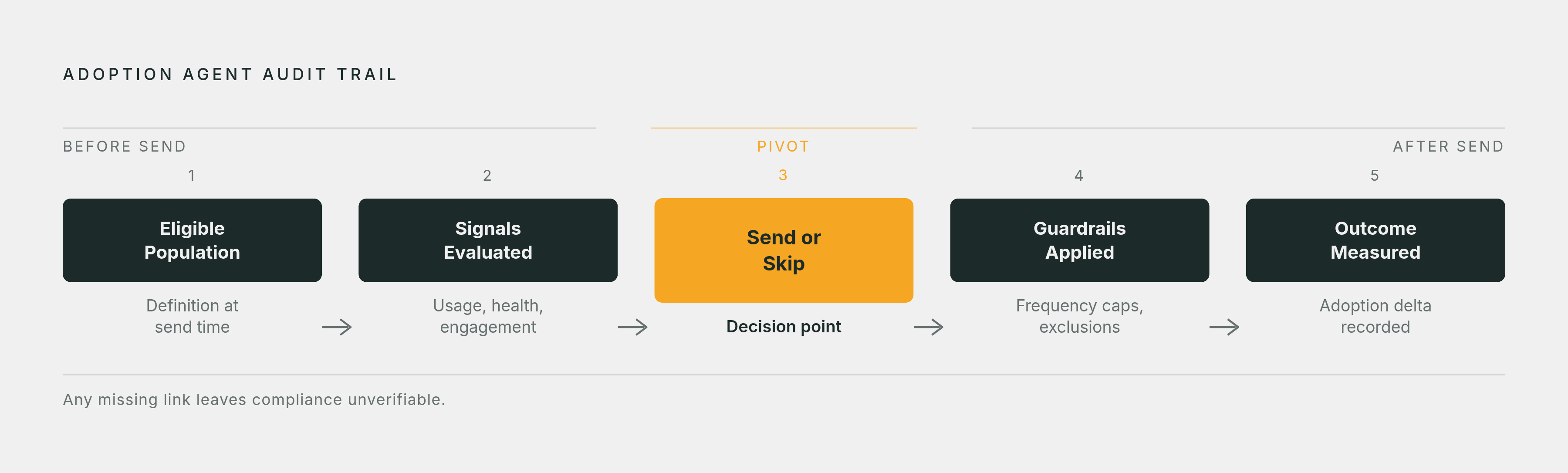
Auditability means being able to reconstruct, after the fact, why the agent messaged a specific person on a specific day. What did it read? What did it conclude? What guardrails did it check before sending? This isn't only a compliance requirement. An agent that can't explain its own reasoning can't be fixed when the reasoning is bad. At minimum, the audit trail should capture the eligible-population definition used at send time, the signals evaluated, the send-or-skip decision, the guardrails applied, and the outcome measured afterward. Auditability is where most teams are thinnest right now, and mature AI governance models remain the exception rather than the rule.
Legal basis and B2B context: what applies to SaaS vendors sending behavioral messages
The frameworks that matter for a B2B SaaS company messaging its customers' employees:
GDPR applies whenever the people receiving messages are natural persons in the EU or EEA. An employee is a natural person, not an extension of their employer, so the fact that the contract sits with the company doesn't take the employee's data outside GDPR's reach. UK GDPR establishes its own parallel framework with broadly similar obligations. CCPA/CPRA covers California residents' personal information, and that includes B2B contacts. A handful of other states, Virginia, Colorado, Texas among them, have their own laws, though unlike California's, these generally exempt B2B contact and employee data. The practical move, given the patchwork, is to build to the strictest standard and apply it everywhere rather than segment compliance by state.
So which legal basis covers behavioral adoption messages? Legitimate interests is the one most B2B SaaS companies lean on, and it's a reasonable fit: helping a paying customer's employee use a product they're licensed to use is a plausible interest to claim. But legitimate interests comes with a balancing test, and it's not automatic. The vendor's interest in adoption and retention can't override what a reasonable person expects about their own privacy. A message that references specific activity someone didn't expect to be monitored can fail that test even when the underlying interest is legitimate.
Contractual necessity is a second option, and it depends entirely on the contract's language. If the agreement with the customer company commits the vendor to onboarding or activation support, messages delivering on that commitment may rest on contract rather than legitimate interests. Consent is rarely workable here. Asking for a checkbox before every behavioral message would collapse the value of running an agent at scale, so most teams should design toward legitimate interests or contract, and document the reasoning either way.
One more wrinkle specific to B2B: the SaaS vendor is often a processor for the customer's users' data and a controller for its own product analytics at the same time. That dual role creates layered obligations, and it belongs in the data processing agreement, not left implicit. None of this is legal advice. Teams should get their specific basis checked by counsel, not inferred from an article.
How campaign-level approval creates a privacy-by-design control point
A campaign works as a container. A human sets the goal (what behavior change matters), the audience (who's eligible), the guidance (what the agent can say and how), and the limits (what it must never do). The agent reasons independently within that container, person by person, but it can't step outside the purpose or audience a human already approved.
That structure maps directly onto the two principles from before. The campaign definition is the documented purpose. The audience definition is the minimization control. Neither one is abstract policy language, they're settings a human configured before the agent ever ran.
Skip-if-unsure logic deserves its own mention here. An agent that sends a message when the evidence is thin isn't just being sloppy, it's processing personal data without enough justification for the intrusion. Building in a hard skip when the signal doesn't clearly support contact is a minimization control, not just a quality-of-life feature.
A few guardrails belong at the send gate itself, not buried in a system prompt where a model can talk itself around them:
- Frequency caps, so no one gets contacted more than their situation warrants
- Quiet hours, respecting time zones and expected availability
- Never-contact flags, honored before any LLM reasoning even starts
Enforce these as hard constraints outside the model, not soft suggestions inside it. And the campaign record itself, goal, audience, guidance, limits, every send and skip logged, doubles as the audit trail the previous section calls for. It shows, after the fact, that every message sat inside an approved purpose and passed through the guardrails that were supposed to catch it.
Surveillance-flavored personalization undermines both trust and utility
A message can clear every legal hurdle and still feel like being watched. That's the test that actually matters to the person receiving it: does the specificity feel useful, or does it feel unsettling?
"We noticed you opened the reporting tab 11 times this week without finishing a report" is accurate. It also makes someone wonder what else is being logged. "We see you've been struggling with X" interprets a person's behavior in a way they never signed up for. Exact timestamps, session counts, error tallies dropped into a friendly message don't read as helpful, they read as evidence of monitoring.
Compare that to personalization grounded in something the user actively did or a milestone they reached, something they'd recognize and expect, rather than a pattern they didn't know was being tracked. The better version points forward: here's a useful next step, not here's what was watched you do. The agent's job is to hand someone something useful, not to prove how much data it has on them.
This matters past trust, too. Messages that feel intrusive drive down engagement and can trigger complaints or opt-outs, which is precisely the outcome an adoption agent exists to prevent. Behavioral data should shape the judgment behind a message. Surveillance shouldn't be visible in the message itself as a demonstration of what was tracked. That instinct belongs in the campaign guidance a human sets, not left for the agent to guess at on its own.
Distinguishing human users from agent activity in behavioral data
A newer problem is starting to surface in 2026: AI agents acting on a user's behalf generate product events that look identical to human ones in the log. Same click, same API call, same feature invocation, but no human decision behind it.
This directly breaks an adoption agent's reasoning. If the event stream is partly synthetic, the agent can conclude a person is active and capable when in reality they haven't logged in for months and an automation is quietly doing the work for them. Sending that person a personalized nudge based on activity they didn't generate isn't just useless, it's processing personal data on a false premise. There's no genuine human behavior backing the judgment.
An account can look retained purely because agent activity keeps running while the actual human has moved on. Standard usage metrics won't catch this unless the event streams get separated first.
Practically, this means adoption agents need some kind of signal-hygiene layer, a way to tell human-generated events apart from automation-generated ones before reasoning about whether a person needs help. This is an open problem right now, not something with a settled answer. Teams building agent reasoning on top of existing analytics stacks should first check what share of their event volume is even human-generated. And it loops back to auditability: an agent that can't say whether the signals it acted on came from a person can't prove its judgment was grounded in real human need. That's an incomplete audit trail no matter how clean the logging looks.
What a privacy-compliant measurement architecture looks like for adoption outcomes
Measuring an adoption agent means asking whether someone opened a message. It's whether they went on to do the actual behavior the message was aiming at. That keeps the measurement anchored at the product-behavior layer, where the agent actually operates, instead of the channel layer, where opens and clicks live.
The denominator changes what the adoption rate actually measures. Feature adoption rate is users who reached meaningful use divided by users eligible to use the feature, times 100. "Eligible" gets defined by plan, role, and permission, the exact fields sitting in database state. Defining that eligible population narrowly, limited to people the feature is genuinely relevant to, is good measurement practice and a minimization practice at the same time. The agent should only be touching data on people it has an actual reason to address.
Observed adoption after a message isn't proof the message caused it. A user might have reached that feature on their own, message or no message. This isn't just intellectual caution for its own sake. Overclaiming a causal effect inflates the apparent value of intrusive processing, and that inflated value becomes the justification for collecting even more data next time. Keeping that claim honest is part of keeping the whole system honest.