AI Agents vs Rule-Based Automation in Product Engagement
AI agents decide whether to act by reading context; rules just match conditions and fire regardless.
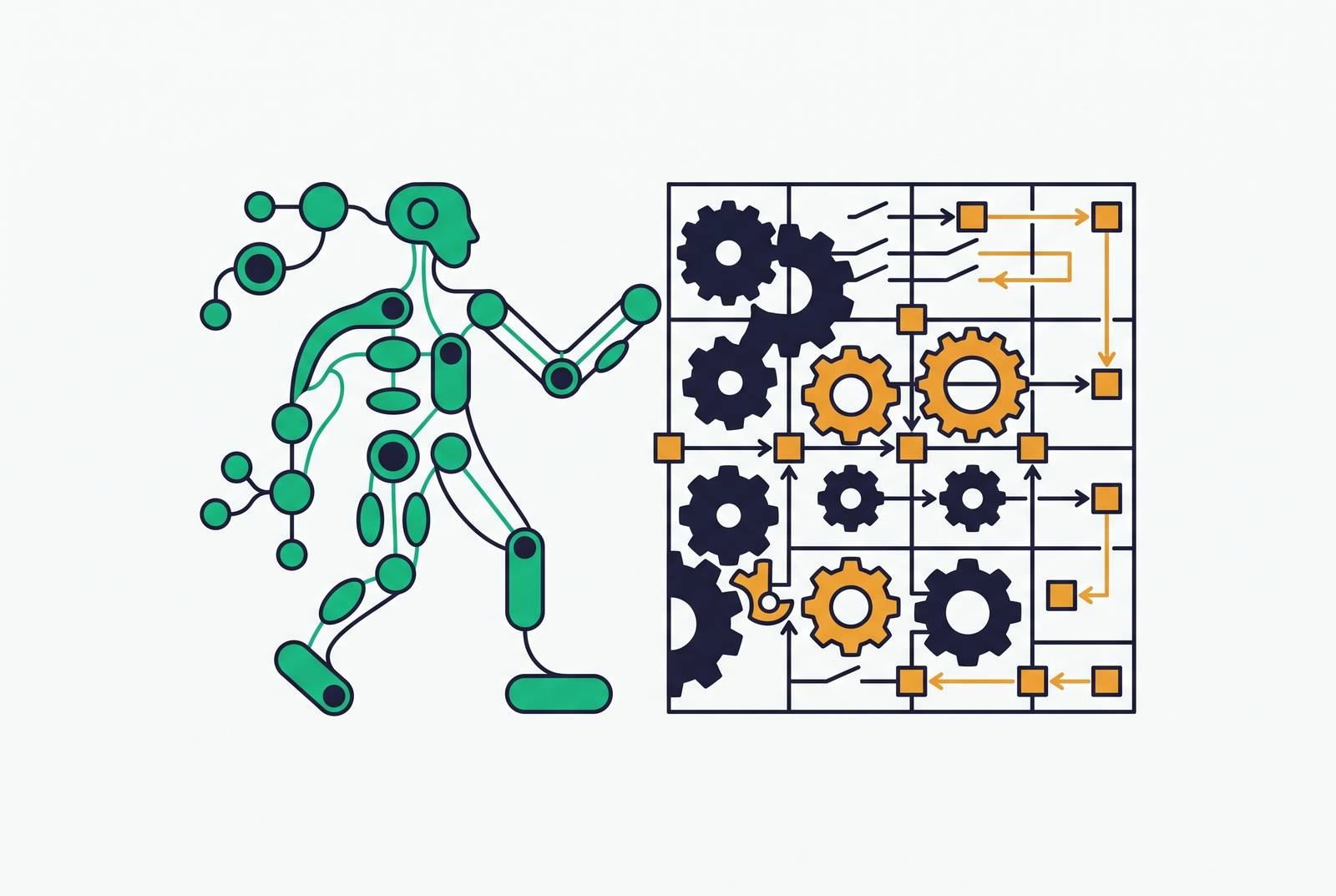
Rule-based automation and AI agents are not two points on the same scale of sophistication. They decide whether to act in fundamentally different ways, and that difference, not budget or feature count, is what should determine which one a product or growth team reaches for. Understanding that gap matters for any B2B SaaS team trying to drive feature adoption without adding headcount to customer success, because the two tools solve different parts of that problem, and mixing them up wastes both.
Rule-based automation versus AI agents: an architectural difference
A rule-based system runs on deterministic logic. If condition X happens, it does action Y, every time, with no evaluation of whether acting makes sense in that particular case. The system checks for a pattern and fires the moment it finds one. It cannot ask whether the pattern actually means anything for this specific person at this specific moment. That rigidity is also where the design earns its keep: rule-based systems are predictable and easy to audit, which counts for a lot in a stable, well-understood workflow.
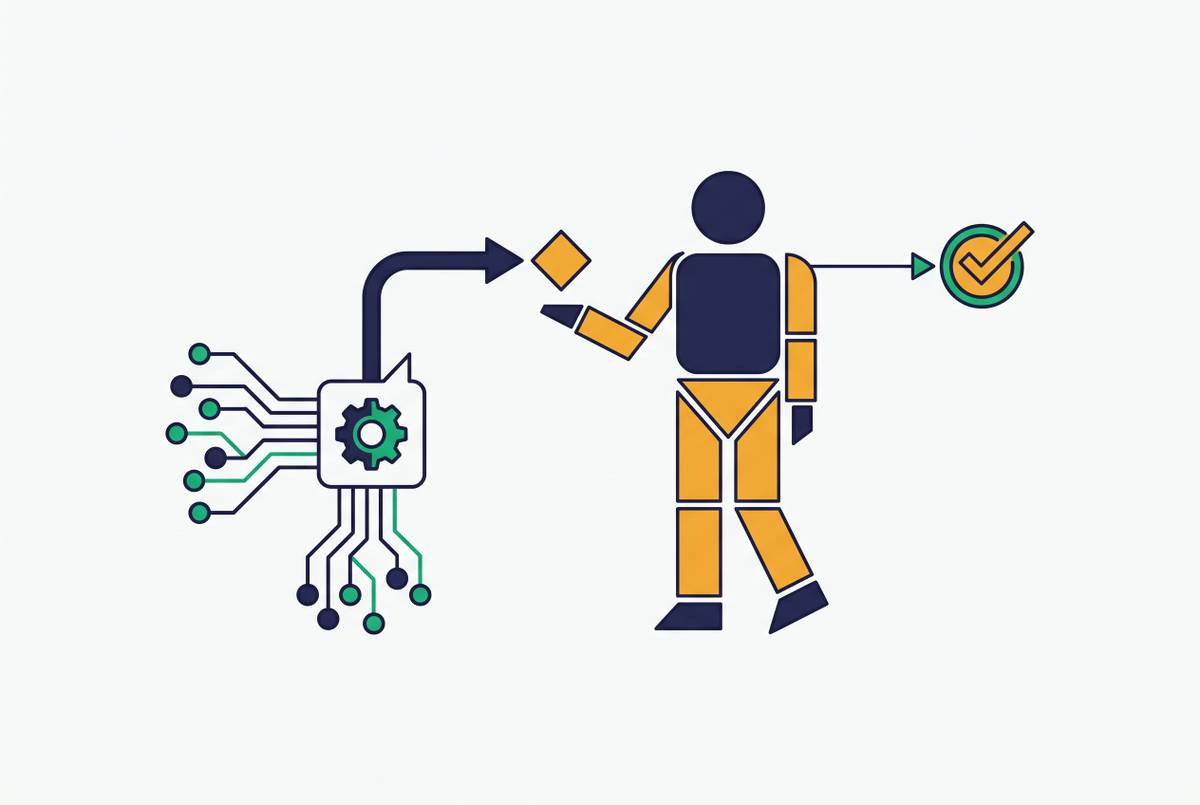
An agent works through a loop instead: it looks at the situation, forms a plan, takes an action, checks the result, adjusts, and starts again. That loop is the real line between an agent and a feature that just sits and waits to be triggered by a person. A feature takes some input, runs it through a model, and hands back an output. An agent keeps working toward a goal until it's reached. And because an agent reasons through a situation rather than matching a pattern, it can land on the conclusion that acting isn't warranted at all, a conclusion a rule-based system has no way to reach.
Picture a system that detects "user visited pricing page." A rule-based setup sends the same message to every single visitor who trips that condition. An agent, instead, reads that visitor's full account history, their behavior over time, and what's actually happening with their account right now, before it decides whether any message is justified. That upkeep burden is a sign the underlying design is brittle.
What this distinction looks like in product engagement specifically
In product engagement, this plays out as acting because a condition matched versus acting because something about this specific person's situation calls for it. Three common rule-based tactics show the pattern clearly: a tooltip that appears after someone visits a feature page three times, an onboarding email that goes out a fixed number of days after signup no matter what the user has done since, and an upgrade prompt that fires the moment a usage counter crosses a set number. Each one fires on a match. None of them stop to check whether the user already finished the task, already upgraded, or already got help from support on the exact same issue.
An agent handles the same situations by reading the user's current state, plan, role, how their account is configured, alongside their behavior over time, before deciding what guidance (if any) actually makes sense. Someone who keeps visiting a reporting page but has never exported a report might genuinely need a short walkthrough. Someone on that same page who already exported something successfully needs nothing at all, and sending them a tooltip anyway just adds noise. The agent can skip, and that skip is a real decision, not a gap in coverage.
That's the shift agentic workflows make possible: picking up real-time signals about what someone actually wants and deciding, on the spot, what to do next, so the experience moves at the pace of that person's own behavior instead of running on a generic drip schedule everyone gets regardless of where they are. The decision to skip carries as much weight as the decision to send. A message that lands on someone who's already succeeded doesn't just miss, it chips away at trust, and it inflates the engagement numbers without moving anyone's actual behavior in the product.
Where rule-based automation still belongs
None of this makes rule-based automation obsolete. It's the right call anywhere the condition is a clear yes-or-no, the correct response never changes, and being able to show why something happened matters more than reading context. A plan limit should block an action every time, without exception, and nobody needs an agent weighing in on that. Permission and access control should fire the same way every time by design, because unpredictability there is a liability, not a feature. High-volume, stable flows, like sending a receipt after every transaction, are also squarely rule territory, because every instance of that condition deserves the exact same response.
Rules also belong as guardrails on top of agent decisions. Frequency caps, quiet hours, do-not-contact flags: these should be locked in at the point where a message actually goes out, enforced the same way every time, not left for an agent to reason about case by case.
Traditional automation does its job well in workflows that are genuinely structured. The trouble starts when a team applies that same rule-based logic to situations where the right move depends on information the rule was never built to see. And rules get expensive at scale in a very concrete way: every new edge case means a new branch added to the system, and the integrations holding it all together pick up enough technical debt that RevOps teams end up spending real hours just keeping the thing from breaking.
There's a simple test for which tool fits. If someone can write the decision rule on a whiteboard in five minutes, and that rule will still hold up in six months without needing a rewrite, a rule is the right choice. If getting that rule right depends on knowing things about the individual person that shift over time, an agent is the better fit.
The activation gap that rule-based automation cannot close on its own
Rules weren't built to solve feature activation. Most features that ship never reach real adoption. Passive launch tactics, release notes, announcement emails, in-app banners, all depend on the user noticing the new feature and figuring out on their own what it's for and why it matters.
Rule-based triggers do better than pure passivity, but they still fire on conditions that look the same for every user. A rule can't tell whether someone genuinely needs the feature, is already using it, or has nothing to do with it given their job. A scheduled email goes out no matter what the person has actually done. A behavior-triggered rule waits for a counter to hit a number, but it still has no way to read why that person is sitting at that number.
A handful of moments carry most of the weight here: someone stuck during setup, a paid feature nobody's touched, repeated searches through help docs, a feature a user specifically asked for that just shipped, or clear signs an account is ready to expand. Spotting which of these moments applies to which person, and doing it well, is where judgment earns its keep, and it's exactly the kind of judgment a fixed rule can't supply.
Trying a feature once isn't the same as adopting it, and that distinction shapes what counts as real adoption here too. One use driven by curiosity isn't adoption. Adoption is repeated use that becomes part of how someone actually works, driven by real value, and a rule-based system has no way to tell those two apart once the first touch is done.
What agents add: reading current state and behavior together
Agents don't out-adopt rules by being cleverer with the same information. They pull together two sources of information that rule-based systems usually keep apart: what's happening in the account right now, and how the person has behaved over time. Current state means plan, role, which features are set up and which aren't, what the account looks like today. Behavioral history means what the person has actually done, what they haven't, where they've gotten stuck, what they've tried over and over without finishing. The gap between what someone's plan and role suggest they should be doing, and what they're actually doing, is the exact signal an agent can act on.
A plain automation handles something like "lead fills out a form, create a CRM contact." That's a single step with no judgment involved. A system built to identify high-intent signals, judge fit, write a personalized message, and decide what to prioritize as conditions shift, is doing something else entirely: orchestration, not a one-step workflow.
Applied to product engagement, this looks like matching the response to the person. Someone who keeps returning to a reporting page probably needs a short walkthrough of the analytics. Someone who's opened several support conversations about setup probably needs a checklist. A heavy user whose requested feature just shipped probably needs a direct note about it. A rule-based system might catch one of these signals in isolation. Reading all three together, for one specific person, is a different kind of task.
Userlens's product, Lumi, is one working example of this design. It reads a person's actual product usage next to their current account state, writes the message that fits what it finds, and holds back when the evidence for sending isn't there. Sending and skipping both come from the same evidence, read together, rather than from separate rules bolted on after the fact.
How human-in-the-loop design limits agent autonomy
Giving an agent more autonomy doesn't mean giving up control over it. The fix for the risk agents introduce is building the approval structure so that whatever freedom the agent has stays inside limits a person set in advance, not loose in the system. An agent runs its reasoning loop without stopping for approval at each individual step. An agent still operates under oversight, just not oversight that approves each step.
The way this works in practice is to split oversight into two layers. A person sets the goal, the audience, the guidance, and the limits, once, up front. That's the strategic layer. Inside that frame, the agent looks at each eligible person on its own and decides, based on the evidence, whether sending something is justified. That's the tactical layer, and it happens without someone signing off on every individual message. The person isn't approving each message one by one; they're setting the conditions under which any message is allowed to go out.
For product engagement, that structure plays out as follows: the product or growth team sets the adoption goal and defines the audience once. From there, the agent works through each eligible user independently, inside those boundaries. Anything irreversible, or anything that carries real risk, gets queued for a person to look at before it happens.
The determinism of a rule-based system earns its keep here too, in a narrower but important role. When the condition is binary and the correct response never changes, a deterministic rule is the right tool, no question. But the broader the product's surface area, or the more varied the customer base, the more often a static trigger ends up firing on people it has no business reaching. That's where agents do real work: they can weigh the specifics of a situation and choose to stay silent in exactly the cases where a rule would have fired regardless.
Measuring whether agent-driven engagement changed product behavior
Measuring agent-driven engagement the way marketing has traditionally measured email, opens, clicks, number of messages sent, gives a misleading picture of what happened. What matters is whether the people eligible for guidance actually changed what they do in the product. That's a different kind of measurement, and it starts with changing the denominator.
Feature adoption rate should only count users who actually have access to the feature in question. Including people who were never eligible lowers the rate and obscures whatever real signal exists in the data. That number is harder to calculate than a click-through rate, but it's the number that actually reflects what the agent was supposed to accomplish.
A few measures carry more weight than opens and clicks for this kind of work. Activation asks whether the user completed the core first action tied to the feature. Repeat usage asks whether the feature became something the person actually works with regularly, rather than something they tried once and moved on from. Time to value asks how long it took, from the moment guidance went out, for the person to reach a meaningful outcome. Support load asks whether tickets related to that feature actually dropped once guidance started going out.
The line between trying a feature once and adopting it matters for measurement the same way it mattered for the activation gap. A single use after a message isn't proof the guidance worked. Repeated use, folded into how someone actually works, is the real evidence.
Seeing adoption happen after a message went out isn't proof the message caused it. Some of those users would likely have adopted the feature regardless of whether any guidance reached them. The eligible group that got guidance needs to be compared against a comparable group that didn't, since answering that requires an actual comparison group, not just a before-and-after snapshot of the same population.
That discipline should mirror the discipline built into the agent itself. An agent that's doing its job skips sending when the evidence for acting is weak. A team measuring that agent's impact should hold itself to the same standard, and resist calling something a win when there's no real comparison backing it up. That's really the payoff of understanding the architectural gap this piece opened with: if a team can't tell whether its automation changed real behavior, it has no way of knowing whether rules or agents were ever the right call to begin with.