Role-Based Onboarding for Multi-Persona B2B Products
Route B2B onboarding by role, not by calendar or shared checklist.
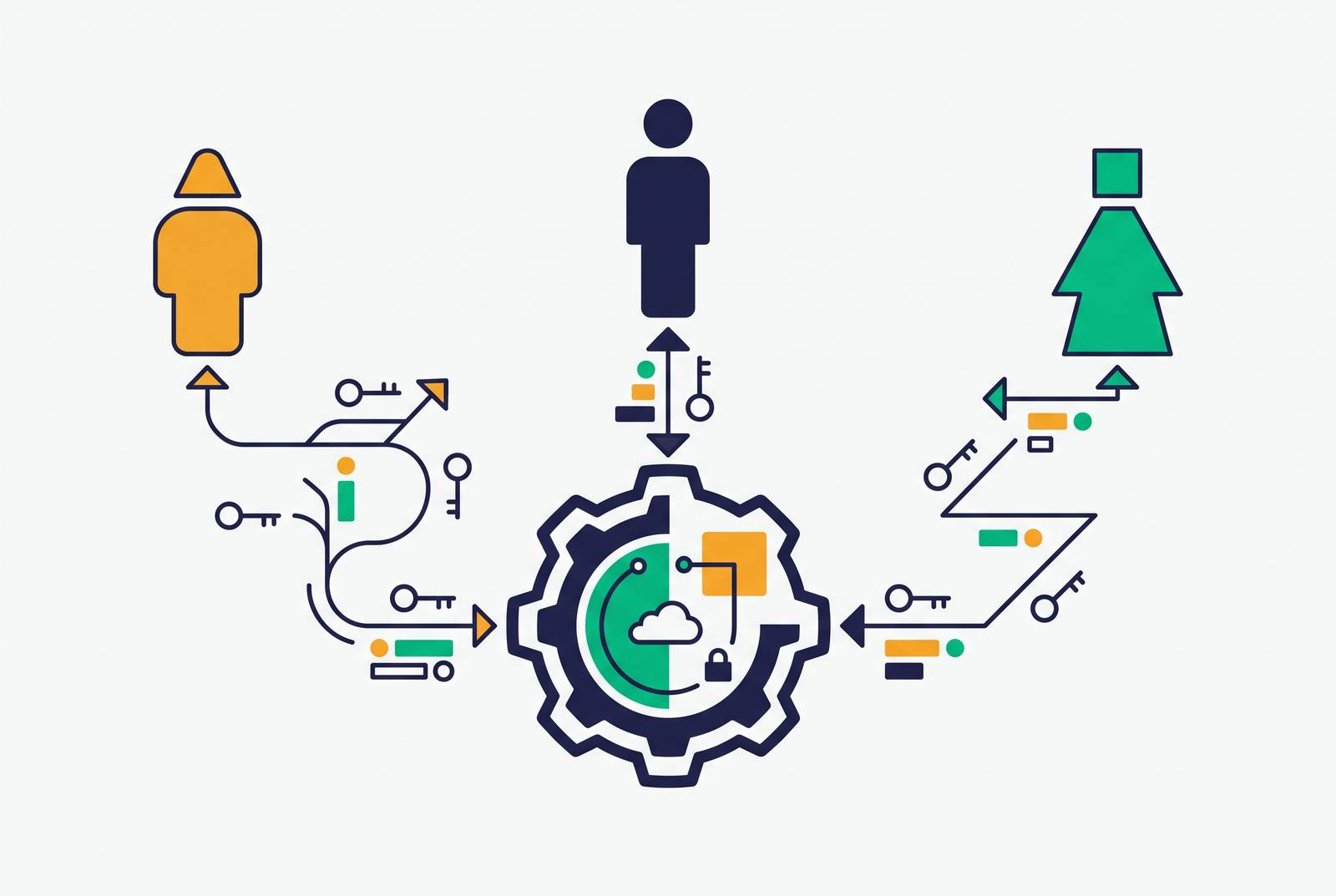
A single onboarding flow built for a multi-persona B2B product fails structurally, because the evaluator, the admin, and the daily end-user are different actors with different goals, and a path built for none of them produces account-level failure that aggregate metrics hide. Behavior-based onboarding emails solve this by triggering on what each person actually does in the product, not on a calendar, and by routing each role toward its own activation event rather than a shared checklist. The rest of this piece lays out how that routing works in practice, what signals decide it, and how to measure it once it's live.
The structural answer is to build three lightweight paths from one codebase rather than five separate experiences, using signals that are available at or before signup to do the routing automatically. An email domain lookup resolves company size and likely role before the user sees a single screen; a single optional self-reported role question shifts the feature tour order from that point forward; and behavioral signals from the first session handle anything those two miss. Three to five persona buckets is enough to route well without creating a maintenance burden. Each path points toward a different activation event: admin activation means setup is complete and repeatable, end-user activation means a first meaningful task finished without hitting unfinished configuration, and champion activation is a recurring milestone workflow with no end date, not a one-time checklist. The lift in every documented case of this approach comes from pointing each role toward a different success event, not from polishing copy inside a shared flow.
Why a single onboarding path fails multi-persona B2B products
Three different people touch a B2B product before it ever becomes a renewal. One evaluates it, one configures it, one uses it every day. The evaluator needs proof of value. The admin needs to finish setup. The end-user needs to get a first real task done without tripping over a configuration nobody finished.
That's a design failure, not a copywriting problem. Jimo's analysis of SaaS onboarding traces the industry's low activation rates to measurement and design choices, not weak content, and names the single shared flow as one of the structural causes.
The damage hides inside the numbers teams already track. An account-level activation rate that looks fine on a dashboard can be sitting on top of a strong result for one persona and a quiet collapse for another, with the product treating both the same way the whole time. Nobody notices because nobody is looking at the role level. More than nine in ten customers saying the companies they buy from could do onboarding better is a wide-open opportunity for any team willing to stop treating onboarding as one flow and start treating it as three.
The three activation events that replace the single "aha moment"
Role-based onboarding starts by throwing out the idea of a single "aha moment." Admin activation, end-user activation, and champion activation are three distinct events, each with its own definition and its own path.
Admin activation means the product is configured for the whole team, and that path has to be setup-first rather than feature-tour-first. WorkOS's guide to B2B onboarding makes the point directly: an admin's first questions are almost never about features. They're about trust and integration, how authentication works, whether access is secure and compliant, whether directory sync is handled. A self-serve admin portal that lets an IT lead configure SSO, verify a domain, and provision users without opening a ticket with engineering turns what used to be a slow manual phase into a real product experience. Once that setup is complete and repeatable, onboarding stops depending on a support team's calendar and starts scaling on its own.
End-user activation means completing a first meaningful task without getting stuck behind a setup that isn't finished yet. This path should only open once the admin's path has closed. If end-users arrive before the product is actually configured, they stall, and the account churns faster than it would have otherwise. There's a specific trap inside this: when admins invite teammates before activating their own setup, they create a dependency loop that reliably produces weaker multi-user adoption down the line. The end-user path itself needs to be feature-first and task-first, never setup-first. Routing a marketer to API documentation as their first screen loses that person in about ninety seconds. Routing the same marketer to a campaign template they can edit live, right away, is what activates them.
Champion activation is different from the other two because it never resolves in a single moment. Champions are the people who justify renewal or expansion to leadership later, and what they need is milestone data that appears at usage thresholds over time, not a one-time activation flow they complete and forget. Their path is a recurring workflow that keeps making value visible, with no end date.
Aggregate activation numbers obscure exactly which of these three roles is succeeding and which is stalling, and that problem doesn't stop at onboarding. It continues into everything that happens after launch.
How do you route multiple stakeholder roles to separate onboarding paths without building five separate experiences?
Routing doesn't require guesswork. Three signals, available before or at signup, are enough to branch a flow into role-specific paths before anyone sees a dashboard.
The first signal is the email domain. A domain lookup resolves company size, industry, and a reasonable guess at role before the user has seen a single screen. ×marble's 2026 analysis of onboarding personalization lays out how different the outcome looks: a 5,000-person enterprise signing up gets prompted to set up SSO and invite a security admin, while a 12-person seed-stage startup signing up for the same product gets prompted to import from a spreadsheet and connect Slack. Same product, two completely different first screens, decided entirely by domain before any behavior exists to react to.
The second signal is a single self-reported role question, asked once. Canva's "What will you design?" is the standard example: one tap, and the templates, tutorials, and integrations a user sees for weeks all shift around that answer. In B2B SaaS, this maps to a handful of personas, engineer, marketer, admin, founder or generalist, each getting a different feature tour in a different order. The question has to stay optional, with a sensible default if skipped. It personalizes the path; it shouldn't feel like an interrogation before access. And the bucket count matters: three to five firmographic groups is enough to route well, while dozens of variants turn into a maintenance burden with no proportional lift.
The third signal is behavioral: what a person actually does in the first session. Behavioral branches, where the user did X and the product shows Y, consistently beat time-based drip sequences on trial-to-paid conversion. For integration-dependent products like analytics, CRM, observability, or billing tools, the integration step itself is the activation event. Products in that category front-load it because completing an integration in the first session correlates with sharply higher retention later.
None of this works at scale without modeling the product around organizations rather than individual users. WorkOS's guide describes tying users, domains, and policies to an organization structure that mirrors how B2B customers actually operate, enabling just-in-time provisioning, domain-based routing, and lifecycle management without someone manually intervening every time. That structure is what prevents the account sprawl and duplicate-account mess that makes end-user onboarding feel broken even when the admin's setup went fine.
The strongest evidence for role-based routing comes from teams that actually split one flow into several and measured the difference. The lift in every documented case comes from pointing each role toward a different success event rather than polishing copy inside a shared flow.
One case, an anonymous PLG SaaS company building a collaboration and API monitoring feature, documented in CompetitorScan's feature adoption case studies, ran nine months of role-segmented adoption campaigns. None of that came from a single redesign. It came from routing different roles toward different adoption events and letting the gains compound across the cohort.
Figma stands as the clearest large-scale example of the same mechanism. Value Add VC's 2026 analysis of product-led growth documents Figma's strong revenue and net dollar retention as a function of team and enterprise plan expansion, not individual-user upgrades. That expansion motion depends on a multi-persona activation model: an individual creator gets activated first, then a team forms around that creator's work, then an enterprise admin steps in to manage it at scale. Each of those three roles needed its own path before the next one could expand on top of it.
Why AI-powered role routing is compressing time-to-value industry-wide
The tools available for routing by role have changed enough in the last couple of years that the competitive bar has moved with them. Litmos's 2026 analysis of SaaS onboarding trends names AI-powered, role-based onboarding as the new baseline: adaptive learning paths that adjust to a user's skill, behavior, and product usage, predictive scoring that flags at-risk users before they disengage, and AI-assisted content that delivers the right guidance at the right moment without someone manually curating it. The same analysis points to multi-audience academies replacing single-stream onboarding altogether, a single hub delivering tailored paths to customers, partners, and internal teams at once, without headcount growing to match.
The benchmark for what counts as strong activation has risen with these tools. Flowjam's PLG playbook notes that activation levels once considered elite are now closer to the floor, because AI-assisted onboarding compresses the time between signup and first real value for a far larger share of users than manual flows ever reached.
Most teams know this shift is happening but haven't closed the gap between knowing and doing. OnRamp's 2026 survey of CS and revenue leaders found that most respondents say AI has already cut onboarding friction and let their teams scale without adding headcount. Only a small fraction rated their own AI maturity as advanced, and fewer than a third said AI is embedded end-to-end across their onboarding workflows. The distance between using AI and using it well sits in that gap, between a generic drip sequence that mentions a role by name and a system that actually checks each person's current product state before deciding whether a message is warranted at all.
Userlens's adoption agent, Lumi, sits in that second category. It reads raw product usage alongside current database state for each person, writes a grounded, specific message when the evidence actually supports sending one, and skips the message when it doesn't. The idea behind it is close to what a founder gives the first ten customers by hand, that close attention to what each person is actually doing, applied at the scale of ten thousand accounts. Champion activation depends on this kind of ongoing visibility because it's a recurring workflow rather than a one-time checklist: someone has to keep track of who's moving and who's stalled, and surface the specific next action that compounds each champion's value evidence at the moment it matters; milestone data alone doesn't finish that job.
Measuring activation at the role level rather than the account aggregate
Role-based onboarding only becomes a revenue argument once it's measured at the role level, with a denominator that isn't lying to the team reading the dashboard.
The denominator decides whether a number means anything. Feature adoption should be calculated against eligible users, the people who actually have access to a given feature based on their plan, role, and permissions, not against every active user in the account. MeltingSpot's 2026 guide to user adoption metrics gives the formula directly: users who completed the adoption event, divided by eligible users. Dividing by all active users instead inflates the denominator and makes adoption look artificially weak. A core feature that's supposed to deliver the product's primary value should clear a clear adoption threshold among the users who are actually eligible for it. If it falls short, that's an onboarding or discoverability failure, not evidence that demand for the feature doesn't exist.
Usage and adoption aren't the same event, and a first click isn't the same as a second use. A role-based system needs to track whether the admin's setup held up under real use, whether the end-user came back to complete a second task after the first one, and whether the champion's milestone data kept accumulating instead of flattening out after week one. Once routing has placed each person on their own path, the period right after signup is where all three of these get decided: the admin needs proof the setup is actually working, the end-user needs to get through a first task cleanly, and the champion needs an early win they can see for themselves. In-product onboarding alone often misses these moments, especially for anyone who hasn't opened the dashboard again. Prescriptive messaging triggered by behavioral data and account state, the kind of thing Userlens delivers, can reach each persona at the specific point they're most likely to move, whether or not they've logged back in to see it.
Measured this way, role-based onboarding is a number finance and product can both read off the same dashboard: which role is activating, which one is stalling, and what that's costing the account in renewal or expansion revenue down the line.