AI Agent Personalization Using Combined Product and CRM Data
Combining product data with user behavior prevents AI agents from sounding wrong or tone-deaf.
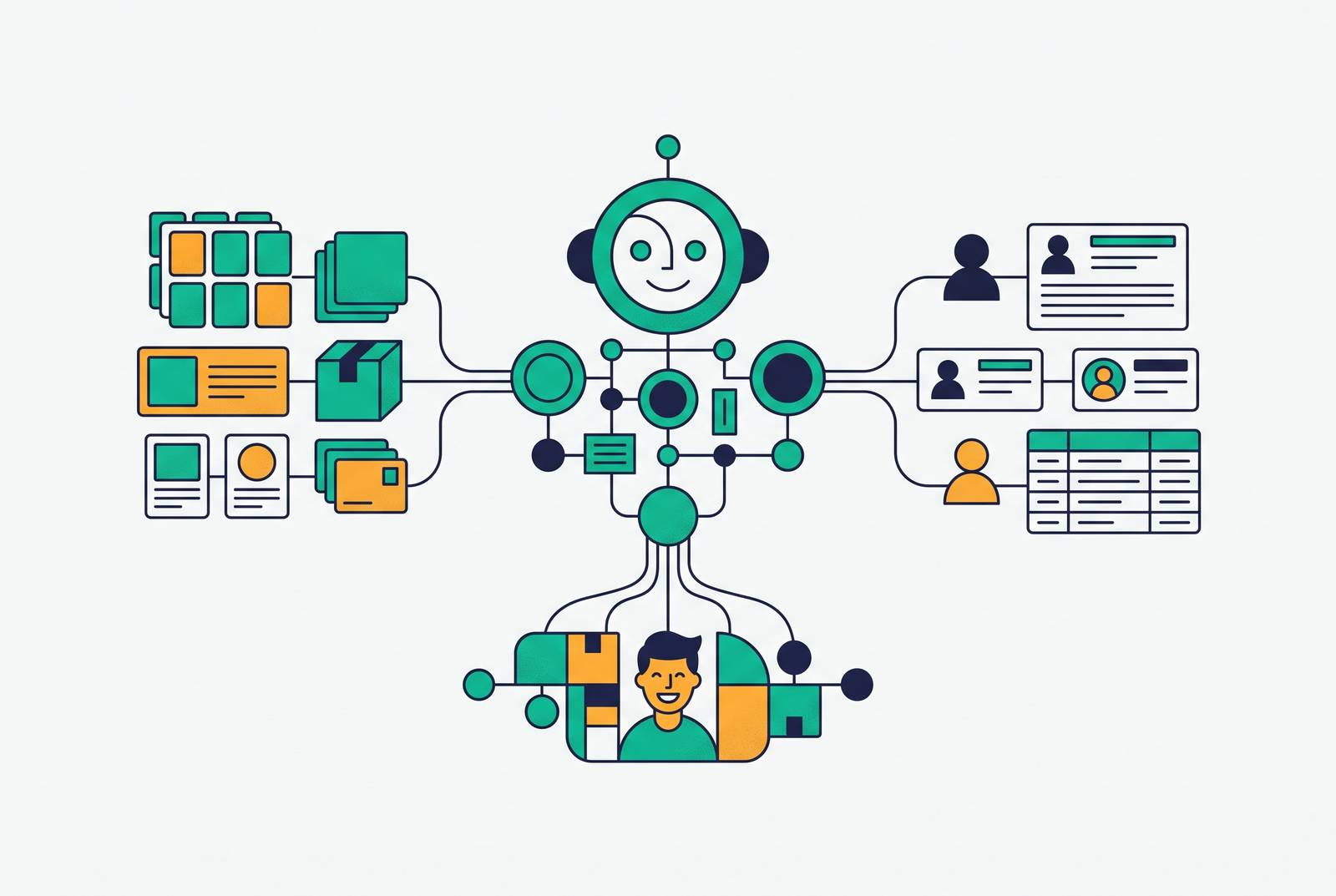
AI agent personalization in B2B SaaS depends on combining two distinct data layers: current database state (plan, role, seats, configuration) and behavioral history (what a user has actually done in the product over time). Either layer alone produces a predictable failure. The agent either sounds accurate but out of touch, or sounds observant but wrong about what the user is actually allowed to do. This piece breaks down why the combination is the only architecture that produces a message worth sending.
Why either data source alone produces a blind spot
Picture an agent that knows a user sits on an Enterprise plan and holds the admin role. It sends a message about advanced configuration settings, the kind of outreach that sounds tailored and well-timed. The problem: this user finished that exact setup three weeks ago. At worst, it reads as proof the product isn't paying attention to the very account it claims to understand, the contextually accurate but behaviorally blind failure. The agent had the role and the plan right. It had no idea what the person had already done.
Running the failure in the other direction does just as much damage: an agent watches product telemetry and notices a user has never touched a collaboration feature. It fires off an activation nudge, the standard move for anyone who looks like they're under-using the product. Except this user is a read-only analyst on a Starter plan, and the collaboration feature is gated behind a tier they don't have. The nudge doesn't just miss. It confuses the user about what they're even paying for, and confusion like that erodes trust fast. That's the behaviorally aware but contextually wrong failure: full visibility into actions, zero grounding in what those actions mean for this specific account.
A CRM alone functions as a passive record-keeping system. It records what a customer is, since activity from emails, meetings, and calls rarely makes it into most CRM records, leaving out what actually happened in the interactions that define their relationship to the product. The two failures above aren't random noise from a system that needs tuning. They follow directly, and predictably, from which data layer the agent is missing. The fix is architectural: the agent needs both layers, structurally, before it writes a single message.
What "database state" and "behavioral history" each contain
The two layers aren't just different sources feeding the same kind of information. They are different in kind. Database state describes what's true about a customer right now: plan tier, contract stage, seat count, billing status, configured features, SSO or integration setup. It's a snapshot, current and factual, but frozen in time. Behavioral history describes what that customer has actually done over the life of the account: specific product events, workflow completions, idle stretches, the sequences of action that separate someone building a habit from someone who tried a feature once and never came back.
Database state alone can't tell you whether a user has touched any of the features technically available to them, whether their actual behavior lines up with what their role would suggest, or whether a configuration they set up months ago is still in active use. It's a profile, not a record of action. Behavioral history has the mirror-image gap. Telemetry alone can't tell you whether a user's observed behavior is expected given their plan and role, whether they simply haven't discovered a feature they do have access to, or whether a stretch of inactivity is a warning sign or just how that type of account correctly uses the product. Engagement data, on its own, has no sense of context to measure itself against.
The shift underway in B2B software is a move away from single-step AI features and toward autonomous, multi-step workflows that need richer input to function. That shift only works if the agent driving it has state and behavior both in view, because the most useful signal doesn't live in either layer by itself. It lives in the gap between them: what a user should be doing, given their state, compared against what they're actually doing, given their history. A user on a Pro plan with the role "Operations Lead" who has never triggered the workflow-automation feature is a meaningfully different case from an identical-looking user who tried that feature once and dropped it. Database state alone, the two look the same. Behavioral history is what makes them different, and that difference decides whether a message makes sense.
Joining the two layers gives an agent something true to say
When state and behavior are put together, the agent can finally answer the question that actually matters: given what this specific person is, what have they actually done, and what haven't they done that the evidence says they should have by now? That answer is the raw material for a message that's useful instead of generic, and it's the thing neither layer can produce on its own.
The combination does three concrete things for the agent. It allows relevance gating: before recommending a feature or action, the agent can confirm that feature is actually available to this user on this plan, which removes the contextually-wrong failure described earlier. It allows recency grounding: the agent can confirm the user hasn't already completed the action it's about to suggest, which removes the behaviorally-blind failure. And it allows individual specificity: instead of writing to a category ("users like you often..."), the agent can reference something concrete and current about this one person, a feature they accessed, a workflow they started but abandoned, a milestone they crossed, because the behavioral history supplies the fact and the database state confirms that fact actually means something for someone in their plan and role.
The joined signal also tells the agent when to say nothing. If behavioral history shows ordinary usage for a given role and plan, and database state shows no meaningful gap between expected and actual behavior, the correct output is silence. An agent working from behavior alone has no basis for that judgment, because it has no sense of what "normal for this account" even looks like.
Userlens is one example of this architecture built as an actual product. Its adoption agent, Lumi, works from a campaign structure: a human defines the adoption goal and the audience that qualifies for it, and Lumi turns each customer's product behavior into personal guidance from there. The mechanism matches the argument directly. State narrows the field to the people for whom a goal is even relevant. Behavior tells the agent which of those people show evidence of a gap that needs addressing. The output is guidance grounded in both, not a broadcast based on either one.
The cold-start problem: what to do before behavioral history exists
The joined-layer model hits a real limit at the exact moment a new user signs up. Behavioral history at that point is empty by definition, so the agent is working from database state alone, which is precisely the single-source condition the rest of this argument has been warning against. That's a genuine gap, not a flaw in the model. It's solvable, and the solutions scale in fidelity as more history accumulates.
The simplest approach uses firmographic priors: industry, company size, plan tier, and role, to infer likely use cases and a reasonable starting point for messaging. It's less precise than actual behavioral evidence, but it beats a generic, one-size-fits-all message, and its influence fades naturally once real usage data starts coming in. A step up from there is lookalike modeling, which finds existing users with similar state profiles who already have behavioral history, and uses their patterns as a starting prior for the new signup. This only works once there's enough historical data in the system to make the comparison meaningful, so it's a better fit for products with an established user base than for very early-stage ones. The third approach is real-time enrichment: pulling in company size, industry, tech stack, and funding stage at the moment of signup, before the first product event ever fires. This doesn't wait for behavior to accumulate. It makes the state layer itself richer, immediately, so the agent has more to work with from minute one.
All three approaches are proxies, and the agent should treat them as lower-confidence evidence. That means the bar for sending a message in a user's first sessions should sit higher than it does once history exists, and the skip-if-unsure logic described in the previous section needs to be calibrated accordingly: when the only evidence is a profile and a guess, the safer default is to wait.
Data quality in the state layer as the limit on the combination
The behavioral layer, in practice, tends to be reliable. Product telemetry logs what happened, consistently and without much ambiguity. The state layer is what actually breaks the joined-layer model: CRM records that are stale, incomplete, or structurally inconsistent produce grounding errors that no amount of clean behavioral data can fix. A perfect record of user actions means nothing if the system is wrong about who that user is or what they're entitled to.
Duplicate accounts are one common version of this failure: the agent treats two records as two separate customers, which leads it to either send the same message twice or, worse, draw conclusions from a partial, split view of a single relationship. Stale role or plan data is another, and probably the most common of all: a user upgraded three months ago, but the plan field in the CRM never got updated, so the agent recommends a feature the user already has and has already been using for weeks. That message doesn't just miss the mark. It reads as evidence the product has no idea who its own customer is. Missing person-level fields cause a quieter version of the same problem: if the role field is empty, the agent loses the ability to gate relevance by permissions, and it either defaults to a flat, generic message or skips the user when it shouldn't have, both of which quietly drag down output quality. Orphan contacts round out the list: behavioral history exists for a user whose account record has somehow come disconnected from it, so the agent either can't match the two or has to work from an incomplete picture of who that person is.
None of this is a setup task to finish once before launch. Plan changes, role changes, and account restructuring happen continuously in any live customer base, and each one is a fresh opportunity for a grounding error to creep into the system and quietly propagate into bad messages. Auditing the state layer has to be an ongoing discipline, not a one-time project.
There's a useful diagnostic buried in the behavioral layer itself: if a user's observed behavior is consistently out of step with their recorded plan or role, for instance repeated attempts to use a feature their plan shouldn't allow, that mismatch is itself a signal the state record is probably wrong. The agent's skip-or-flag logic can be built to surface exactly that kind of inconsistency, turning the behavioral layer into a check on the state layer as well as a consumer of it.
Campaign boundaries as a guardrail against surveillance
An agent built on joined state and behavior has more evidence about each individual user than any prior generation of personalization tooling. That raises the stakes on scope and guardrails.
That campaign boundary does four specific jobs. It defines the eligible population: not everyone in the database, only the users for whom a given goal is actually relevant given their recorded state. It sets the approved objective, a concrete definition of what successful behavior looks like, so the agent has a grounded target instead of an open-ended instruction to generically "engage" or "activate" people. It establishes send-time constraints, frequency caps, quiet hours, permanent do-not-contact flags, enforced at the point of sending rather than left to the model's judgment case by case. And it gives the agent explicit guidance on tone, scope, and what it's permitted to reference, so the behavioral data available to it shapes the message without turning that message into a visible inventory of the user's last ten clicks.
This is the structure Userlens uses: a campaign defines the adoption goal and the qualifying audience, and Lumi works inside that definition, matching each person against it with a clear reason attached to every match. The behavioral evidence makes the message specific. The campaign boundary makes sure specificity never tips into something that feels like being watched.