Shipping Fast Without Breaking Adoption in PLG Teams
Shipping velocity has outpaced users' ability to adopt new features, threatening the PLG flywheel.
PLG teams are shipping faster than their users can absorb, and that gap is what actually kills the flywheel — more than competitive pressure, more than pricing. OpenView's 2024 benchmark put 60% of SaaS companies in the product-led category, up from 35% in 2021, and 91% of those running PLG said they planned to increase spending on it. The model's entire premise rests on a simple mechanic: the product creates demand, and users pull it into their organizations. That mechanic only fires when users reach value, and reaching value takes attention that hasn't scaled the way shipping velocity has.
The shift is structural. AI-assisted development has moved engineering teams from shipping one or two features a quarter to shipping seven or nine, and the 2025 Stack Overflow Developer Survey found a large majority of professional developers now use AI tools daily. None of that changed how much attention a user has to give a product in a given week. Every new release competes against every feature that already exists in the product, plus whatever else is competing for that user's morning. The result is a widening gap between what the product can do and what users actually do with it, and closing that gap is fundamentally a cadence problem. This piece lays out a framework for treating adoption as part of the release itself, built and shipped alongside the code, rather than something teams get to after the fact.
What the gap actually costs: low feature adoption erodes the PLG flywheel
The flywheel that makes PLG work runs on a sequence: users activate, they find value, they invite teammates, the account expands. Each stage depends on the one before it actually happening. When a feature ships and nobody adopts it, the flywheel doesn't just stall at that feature; it slows every stage downstream of it, because the "job done" moment that would have predicted retention never occurred.
Consider what that absence costs concretely. Users who never see new value have no reason to loop in a colleague. Expansion signals, the product-qualified leads that sales teams want to chase, never form, because the behavior that would have triggered them didn't happen either. The flywheel doesn't fail loudly; it just quietly stops turning at the point where adoption should have picked it up.
Cursor's trajectory shows what it looks like when the flywheel works as designed. Individual developers pulled the product into their companies organically, and corporate buyers grew from roughly a quarter of revenue in late 2024 to nearly 60% by the time the company reached $2 billion in ARR. The product created that demand, one developer at a time, and sales caught up to capture it afterward. That outcome only happens because users reached value first; strip out the activation step and there's no viral pull left for sales to catch.
The operational problem is timing. Teams shipping weekly cannot afford to wait for a quarterly business review to notice a low adoption number. By the time the data surfaces in a dashboard, the window for fixing it in-product has already closed. So the actual question becomes: what has to happen at the moment a feature lands, before the user ever gets the chance to ignore it?
The activation moment that determines whether a feature survives in a user's workflow
Activation isn't a login event, and it isn't even a click on the new feature. It's the moment a user does something real with it and understands, in their own context, why it matters. Anything short of that is exposure rather than adoption.
A rough but useful benchmark: if fewer than 40% of users hit a meaningful first-value moment within a week of encountering a feature, that points to an onboarding or value-proposition problem, and the fix has to happen upstream of any nudge or notification. Time-to-value compresses further than most teams assume; the strongest PLG products get a user to a genuine "wow" moment in two to three minutes, and five minutes is a reasonable ceiling for anything more complex.
Two things have to be true for an activation metric to mean anything in B2B SaaS. First, it has to capture a job actually done, some real unit of work completed, rather than a tour clicked through. Second, it needs a signal of repeatability or collaboration attached to it; In B2B PLG, solo activity is generally a much weaker retention predictor than team behavior, because a single user clicking a button once says almost nothing about whether the workflow sticks.
What breaks this moment, specifically, for a newly shipped feature: defaults configured for nobody's actual context, sample data too generic for the use case to click, and no explicit bridge drawn between the new feature and the workflow the user already relies on. Fix those and the moment holds. Keyhole, the social media analytics platform, simplified its sign-up flow and used in-app prompts to guide users to core features faster, and the company reported a 25% increase in ARR alongside net retention climbing to roughly 70%. That's the difference between a feature that becomes part of someone's week and one that gets forgotten after a single click.
None of this happens by accident, and none of it happens after the fact. Activation is a design and engineering decision, made before the feature ships, and it only holds up reliably when adoption planning is baked into the release, not bolted on afterward.
Why post-launch adoption planning almost always starts too late
The default sequence at most PLG companies looks like this: ship the feature, announce it, wait to see if anyone uses it, then decide whether a help doc is warranted. That sequence has rarely been fast enough. At the shipping cadence AI-assisted development now supports, it's untenable.
The internal mechanics that produce this sequence are worth naming plainly. Design wants time to research the right defaults and the right messaging before anything goes out the door. Engineering wants to ship and move to the next item on the roadmap. Product sits in the middle, mediating between "get it right" and "get it out," and adoption work is what gets deprioritized in that negotiation, every time. The coordination tax is real, and it lands on adoption because adoption has no natural owner fighting for it in the room.
So the gap gets filled with whatever's generic and available: a newsletter blast, a one-to-many in-app banner, a help article nobody searches for. None of it distinguishes between a user who already works in the adjacent workflow and one who has never touched anything like it. Structured onboarding programs have been associated with a 25% increase in first-year retention, but that lift only materializes if the program exists and fires at the right moment for the right user; a program that exists in theory, buried in a backlog, produces none of that lift.
Moving the planning earlier is the fix, so the adoption plan for a feature is written before the feature ships, rather than discovered afterward through a support ticket queue.
Building adoption into the release process: what changes and when
The operating principle is straightforward: every feature ships with its adoption plan already written, rather than improvised once usage numbers come in low. That plan needs to answer a specific set of questions before a single line of the feature reaches production.
Who is this feature actually for? Which behavioral segments in the existing user base already have the context to use it immediately, without a tutorial? What does "activated" look like, specifically, as a measurable action sequence rather than a vague sense of engagement? What does the first encounter feel like for someone who has never touched this workflow before, versus someone who has been asking for exactly this? Which users are likely to need active guidance, and which will self-discover it without any help at all?
Ownership has to be distributed deliberately, not left to whoever has slack in their sprint. Product defines the activation metric and the target segment. Growth or customer success owns the guidance content and the logic that decides when it fires. Engineering's job is to surface the behavioral data that makes segmentation possible in the first place, because none of the rest of this works without clean data underneath it.
Two data sources, combined, tell teams who needs what. Database state describes what a user's account is actually configured to do: their plan, their setup, the modules they've turned on. Analytics behavior describes what they actually do: how recently, how often, which adjacent features they already touch. Neither one alone is enough. The intersection of the two identifies not a segment but a specific next best action for a specific user, and that specificity is the whole point.
Timing changes the outcome as much as content does. Guidance delivered at the moment of first exposure to a feature is a categorically different experience from the same guidance sent three days later, because the user's context is live and their intent is present in a way it no longer is once they've moved on. The strongest PLG products operate on exactly this logic: tracking which tools users adopt first and tailoring in-app suggestions to that specific path, personalizing the expansion journey per account in ways that timing alone cannot achieve. This is less a matter of team size than of the order of operations for the work a team is already doing.
Using behavioral signals to route guidance at the moment a feature lands
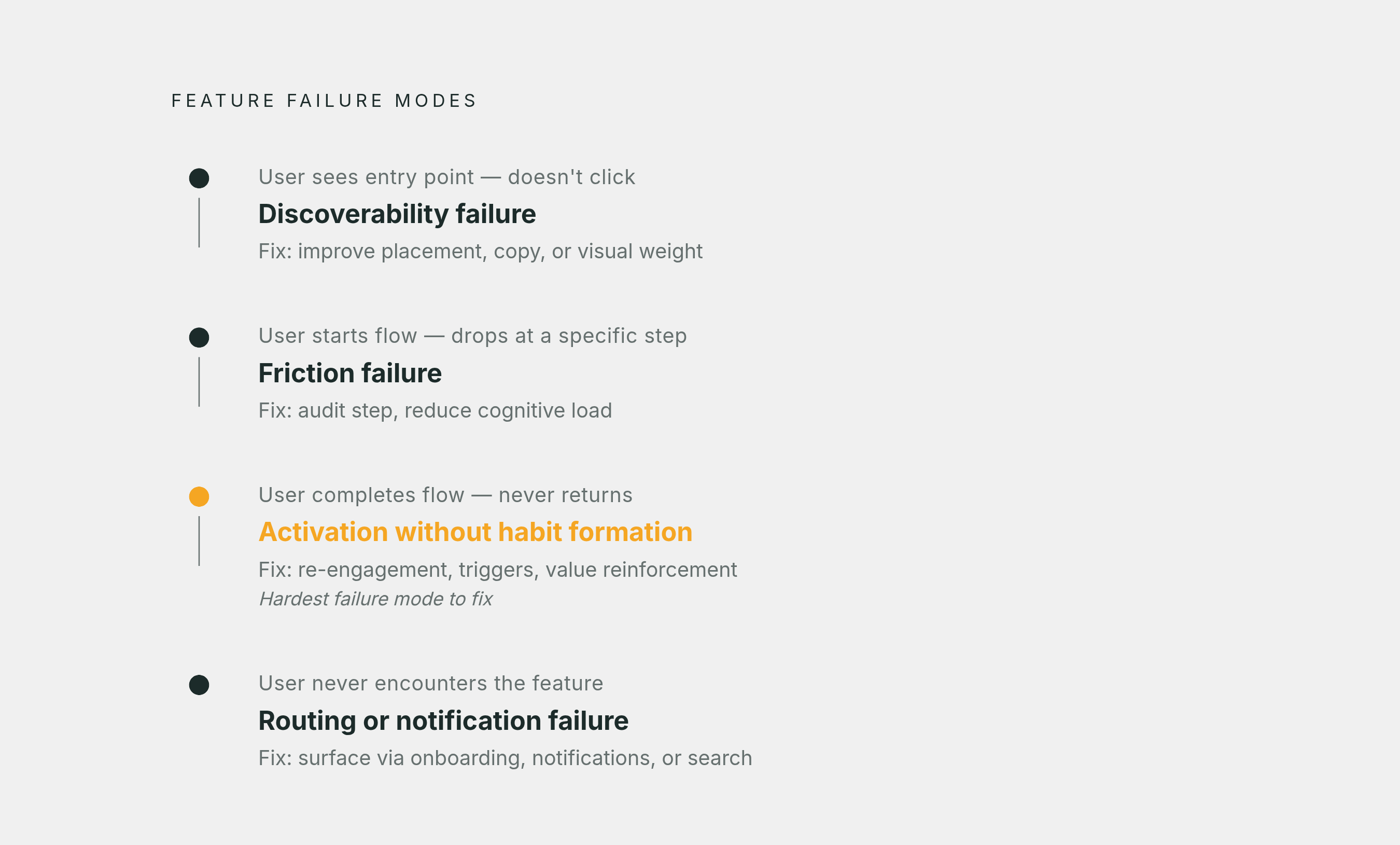
The mechanism underneath all of this is a chain: a behavioral event happens in the product, that event gets classified, and the classification routes a specific piece of guidance to a specific user through whichever channel fits. Four failure modes matter most when a new feature has just landed.
A user encounters the feature's entry point and doesn't proceed; that's a discoverability failure. A user starts the flow and drops at a specific step; that's friction somewhere in the experience, and the step matters more than the fact of the drop. A user completes the flow once and never returns; that's activation without habit formation, arguably the hardest failure mode to fix because the user technically succeeded. A user never encounters the feature at all; that's a routing or notification failure, and it means the guidance system never got the chance to do its job.
Each of those four calls for a different response, rather than the same announcement copy repurposed four ways. Behavioral triggers beat time-based sequences for this exact reason: they fire when the user's context is relevant, not on whatever schedule a marketing calendar happens to dictate. A message that references a user's specific recent activity, something like flagging that a workflow they've run repeatedly this week has a direct extension available, gets attention that templated messaging simply doesn't earn.
The same behavioral read applies to risk, not just opportunity. If a user's engagement drops off after a feature update, that dip is itself a signal, one that can trigger re-engagement before the drop turns into churn. A Forrester forecast found that PLG companies prioritizing Activation Rate and net revenue retention as core KPIs saw revenue grow roughly twice as fast as companies still leaning on MQL-style metrics. Measuring the right thing changes what a team optimizes for, which is a fairly unglamorous but important point: every guided nudge needs a defined behavioral outcome to check against afterward. Did the user's workflow actually change, or did the click just register in an analytics dashboard without anything downstream of it moving?
Where AI agents change the scale equation for adoption
Here's the arithmetic problem plainly stated: a team shipping seven to nine features a quarter, across a user base numbering in the thousands, each at a different stage of familiarity with the product, cannot route adoption guidance by hand. The number of combinations, feature times segment times failure mode, exceeds what any growth or CS team can manage manually, no matter how well-staffed.
AI agents close that gap by applying the kind of individual attention a founder once gave the first ten customers, extended to every user at once, personalized to what each one has and hasn't done. In this context, an adoption agent reads behavioral state per user after each release, identifies which of the four failure modes a given user falls into, generates guidance specific to that user's history, and then checks whether the target behavior actually shifted afterward. That last step is the one most automation tools skip.
Executive pressure on this front is not hypothetical. A 2026 Gartner survey found 91% of customer service leaders reported pressure from leadership to implement AI, and adoption agents fit that pressure precisely because they produce a measurable change in behavior, rather than just a lift in an engagement metric that doesn't translate to anything.
The distinction from generic lifecycle automation matters here. An adoption agent acts on the combination of database state and behavioral data, meaning it knows both what a user's account is configured to do and what they actually do with it, an input a standard lifecycle email tool simply doesn't have access to. The metric that matters at the end of that chain is whether product behavior actually moved, not whether a message got opened. That's what lets adoption keep pace with a shipping cadence that has already outrun what a human team could route by hand, without needing a proportional headcount increase in growth or CS to match it.
When adoption signals become revenue signals: connecting feature usage to PQL conversion
Companies running a formal product-qualified lead framework see conversion rates roughly three times higher than those still relying on traditional MQL funnels. Yet only around a quarter of PLG companies actually run one, which means most of the industry is routing leads off form fills while sitting on usage data that already tells a clearer story about intent.
The behavioral signals that predict conversion overlap almost entirely with the signals adoption tracking already produces: a feature usage threshold crossed, a teammate invited, a paid-feature prompt encountered more than once. Users who hit those signals convert at roughly 25 to 30% according to available PLG benchmark data, well above what cold outreach or generic MQL scoring produces, because the product itself has already done the qualifying work.
The practical implication is that the instrumentation built to guide feature adoption isn't a cost sitting off to the side of the revenue conversation. It's part of the same pipeline. The data that tells a user "here's how to use this feature" is the same data that can tell a sales team "this account is ready for a conversation." Teams that treat adoption tracking as strictly a customer success function are leaving that PQL layer completely unmined, not because the data doesn't exist but because nobody built the routing logic to connect it to revenue.
What a release looks like when adoption is built in from the start
The old sequence bears repeating once more, because it's still the default at most companies: ship, announce broadly, wait for usage data to trickle in, write a help doc if the numbers look bad enough, move on to the next thing.
The alternative looks different in a few concrete ways. A release includes, at the same time as the code: a defined activation metric and a named target behavioral segment, trigger logic for routing guidance based on how a user first encounters the feature, personalized guidance generated from each user's specific behavioral state rather than a broadcast message, and a measurement window tied to a specific behavioral outcome, checked deliberately rather than stumbled upon.
That measurement window is what makes the whole loop actionable rather than diagnostic after the fact. Running feature usage analysis on every significant release, not on some periodic schedule set by a quarterly planning calendar, is what separates a system that catches a very low adoption rate in week one from one that discovers it three months later as a post-mortem line item. By then it's a write-off rather than a finding.
What this protects is the first gate in the PLG flywheel, activation, and everything downstream depends on that gate holding: habit formation, team-level adoption, PQL formation, expansion revenue. None of it happens if the first gate doesn't. The teams that compound fastest from here forward will be the ones that ship the adoption infrastructure for a feature in the same motion as the feature itself, treating guidance, measurement, and re-engagement as part of the release, rather than a follow-up task assigned to whoever has bandwidth. Adoption keeping pace with shipping velocity is the structural condition that lets the model work at all, at the speed teams are now building, well beyond serving as a mere growth tactic layered on top of PLG.